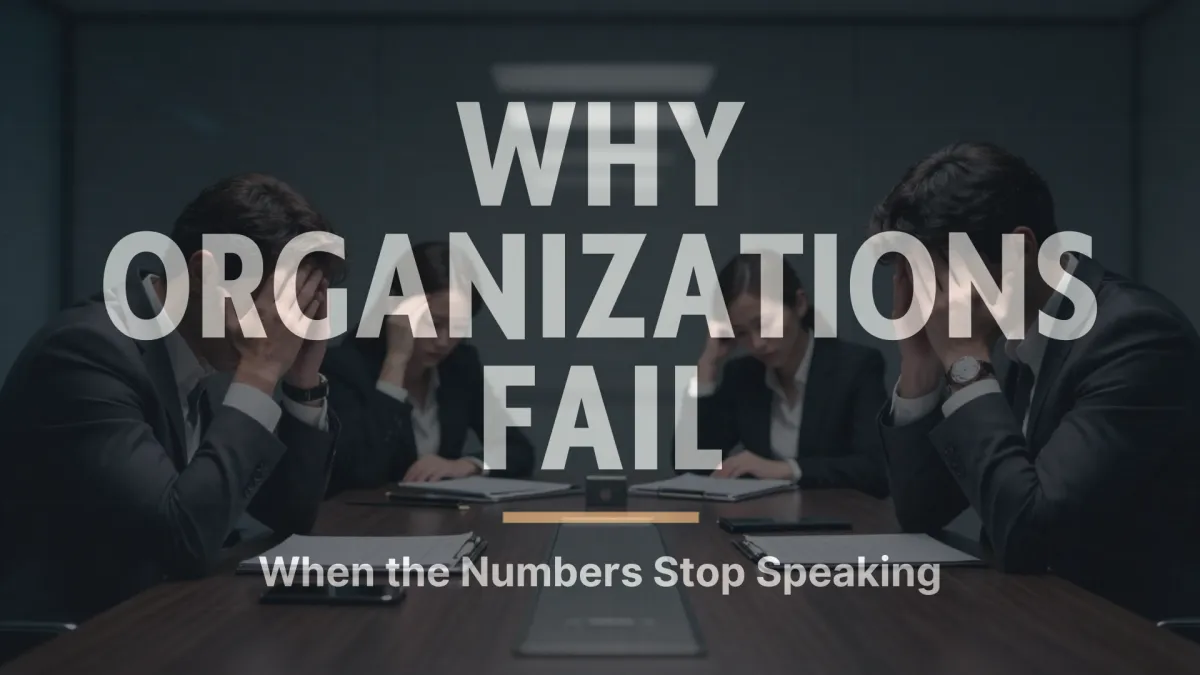
Why Organizations Fail
LEADERSHIP•ORGANIZATIONAL RESILIENCE
Why Organizations Fail Long Before They Run Out of Money
Financial distress is the last chapter of the story, not the first. By the time the numbers turn, the failure has usually been underway for years.
Patrick Marcel Thomas, DBA Business Systems & Financial Strategy
Most leaders believe organizational failure begins with a cash flow problem. A big client leaves. A market softens. Revenue dips below the line that covers payroll, and the scramble begins.
The evidence suggests otherwise.
In researching why organizations collapse, the work behind my doctoral study of firms that failed against firms that endured, one pattern surfaced again and again. Organizations begin failing months, often years, before financial distress ever appears in the numbers. The cash crisis everyone points to afterward is not the cause of death. It is the final symptom of a condition that set in long before.
That distinction matters enormously because it changes where a leader looks for the problem, and when. If you wait for the financials to tell you something is wrong, you are reading the obituary, not the diagnosis.
The Myth of Financial Failure
We are trained to treat the income statement as the scoreboard. When revenue falls, we conclude the business has a revenue problem, and we go hunting for sales. It is an understandable instinct, and it is usually wrong.
Revenue declines are almost always a symptom.
Rarely are they the cause.
A falling top line is the place where the deeper problem finally becomes visible, the moment the water reaches a level high enough to notice. The leak started somewhere else, earlier, quieter. In the organizations I studied, the underlying causes clustered in four places, none of which appear on a profit-and-loss statement:
Weak financial intelligence - leadership that cannot read the organization’s true condition in its own numbers.
Reactive leadership - a posture of responding to crises rather than anticipating them; “ready, fire, aim.”
Poor governance - the absence of systems, controls, and a reliable view of what is actually happening.
Lack of accountability - a culture where financial information exists somewhere but never reaches, or is never owned by, the people steering the ship.
Notice what these have in common. They are all leadership and governance conditions, not market conditions. They are built, or neglected, in the calm years, long before any downturn arrives to test them.
The Four Warning Signs
My research pointed to a coherent sequence, not a list of unrelated problems, but a chain in which each weakness enables the next. Read in order, it is a map of how an organization quietly walks itself toward the edge.
Deficient financial acumen. It begins at the top. Founders and executives are often gifted at their craft, the trade, the service, the sale, but were never trained to run the business behind it. One leader I studied described his own planning process as effectively nonexistent and his operating style as “ready, fire, aim.” Without financial fluency at the top, every decision downstream is a guess.
Inadequate financial infrastructure. A leader who cannot read the numbers rarely builds the systems that produce good ones. No reliable books. No budget. No agreed-upon metrics. The organization operates blindly, unable to see its own condition until something breaks.
External volatility exposing weakness. Then the market moves, as it always eventually does. A downturn, a lost partner, a shift in rates. The shock does not create the weakness; it reveals it. A prepared organization treats the same event as a hard but survivable quarter. A fragile one is broken by it.
Absence of accountability. Running alongside all three is the decisive variable: whether anyone actually owns the numbers and acts on them. In one firm, the person keeping the records described the process as “structured and proactive,” while the founder described chaos. Both were describing the same organization. That gap, between information that exists and information that is owned, is the gap that kills companies.
"Market shifts are typically only detrimental when organizations fail to plan appropriately."
That line, from one of the industry experts in my study, is the whole thesis in a sentence. The volatility is not the verdict. The readiness is.
Why Strong Organizations Survive
If failure is a chain, resilience is the discipline of breaking it, deliberately, in advance, while conditions are still calm. The organizations that endured did not have better luck or gentler markets. They had built something underneath themselves that the others had not.
In my work, I came to call that something The Sustainability Engine™, a model for how durable organizations convert five leadership pillars (financial intelligence, leadership accountability, organizational culture, risk management, and strategic planning) into a single, self-reinforcing capacity for resilience.
I won’t lay out the entire engine here; that is a longer conversation, and several of its components are frameworks in their own right. But the core idea is simple enough to state plainly: sustainability is not one practice. It is what emerges when the right capabilities, systems, and culture work together as a system rather than as scattered parts.
Most organizations have pieces of it. A budget here, a good controller there, a leader who cares about culture. What separates the enduring from the fragile is whether those pieces are connected, whether they form an engine, or just a pile of parts.
From Reactive Survival to Proactive Governance
Which brings us to the heart of the matter, the single shift that separates organizations that last from organizations that scramble.
It is the move from reactive survival to proactive governance.
Reactive survival is the “closing-to-closing” existence, living on the next deal, the next invoice, the next month, with no buffer and no plan beyond getting through. The organization does not steer; it is steered by whatever the market hands it. It feels like a hustle. It is actually fragility wearing the costume of effort.
Proactive governance is the opposite posture. It means knowing your numbers well enough to see trouble early. It means building reserves before you need them, not after. It means a cadence of financial review that turns firefighting into rhythm, and a culture where people own outcomes rather than hide from them. It means treating a possible downturn as something you have already planned for, a scenario, not a surprise.
The difference is not how hard the leader works. Both work hard. The difference is where the work is aimed, at today’s fire or at tomorrow’s foundation.
And here is the part worth sitting with: this transition is available to any organization, at any size, starting now. It does not require a windfall or a perfect market. It requires a decision to govern the business rather than be governed by it.
· · ·
The Question Every Leader Should Answer
Sustainable organizations are not built by accident. They are not the lucky ones who happened to dodge the downturn. They are built, deliberately, through intentional leadership, disciplined financial management, genuine accountability, and sound governance.
The failures I studied were not undone by a single bad quarter. They were undone by years of small, invisible deferrals: the budget never built, the reserve never funded, the hard conversation never had, the number no one owned. The market simply arrived, eventually, to collect.
So the question for every leader is not really about cash flow. It is about posture. It is this:
Are you reacting to today’s problems, or building tomorrow’s resilience?
The numbers will tell you the answer eventually. The point of governance is to know it long before they do.
ABOUT THE AUTHOR
Patrick Marcel Thomas, DBA is a Fort Worth–based consultant, educator, and investor who helps founders, executives, and nonprofit leaders build the financial systems that make organizations durable. He is the creator of The Sustainability Engine™ and a family of frameworks for diagnosing financial readiness and governing toward resilience, derived from his doctoral research on why organizations fail. He works with leaders ready to move from reactive survival to proactive governance.
Consulting • Executive Education • Keynotes: patrickthomas.me
